Showing posts with label Planning. Show all posts

Saturday, February 19, 2011

Table For One: Tips for Solo Dining

(image: VinneT)
One of the perks of traveling solo is the itinerary is yours alone. You have only yourself to argue with on what to see and do. But eating out especially in a restaurant atmosphere can be challenging even for the seasoned traveler. Everyone has to eat and its no vacation to have all meals within the confines of a hotel room or to constantly eat on the go. So here are some tips that may come in handy if you find yourself as the solo traveler.

(image: -Lea-)
Check the time. The wait for a server, the food and the bill adds to the awkwardness of solo dining. Think about eating earlier or later to beat the crowds. Some restaurants do not close after lunch or open early for dinner. During off-peak times, a restaurant tends to be less crowded and the wait staff will likely be more attentive. Plus there are less people around to make you feel awkward. I've always find it more comfortable to have the crowds build after placing my order or while I'm already eating rather than walking in a dining room full of people.

Use the Smart Phone. I find it disrespectful when someone is constantly using or answering their phone when dining in a group. But when you're on your own, use your phone to your heart's content. It's your entertainment to keep from being bored and takes your attention from the couples or groups dining around you.

Bring a book or newspaper. Like using a smart phone to entertain yourself, reading an actual paper or book should help to pass the time. If it's a buffet the paper or book left on the table lets the staff know you're still eating when returning to the buffet line. But think about keeping up with the time and pick up a Kindle or iPad to always have electronic reading material always ready.

(image: mintio)
Be purposeful. Walk into the restaurant confidently as you deserve to be there and want to be there and that the staff should be happy to have your business. The more you let any embarrassment about dining alone set in, the longer it will take to get over it.

Pony up to the bar. Many patrons who are on the go dine at the bar. Ask for a menu to let the bartender know you plan to eat and drink at the bar. Use this as a last resort or if the restaurant is crowded. Otherwise everyone deserves a table and chair.

Be a food critic. Because I usually take notes while traveling so I remember the "where, when and what" to document my travels, I just make believe I'm a critic reviewing the restaurant. It makes me feel less awkward once I start photographing the food.

(image: *Jeremia's*)
Sit by the window. The nice thing about window seating is you can stare out the window rather than staring at everyone else in the restaurant.

See solo diners abound. If you see the restaurant is catering to solo diners, then by all means you know you know you won't be the only one.

Keep it pleasurable. A solo diner's business is as good as any other patron's so relax and enjoy the experience. Choose a restaurant because you want to dine there. The service should not waver just because you're a party of one. Remember the restaurant wants to earn your business and the servers a tip.

Tuesday, February 15, 2011

Things You Should Know About Travel Guidebooks

(image: Blacknell)
Many people depend on guidebooks especially with trusted names like Frommer's and Fodors. They are still a good resource for a relaxing way to read about a destination at leisure. However in a static and opinionated world, there are some things prospective travelers should know about the guidebooks when purchasing. As travelers become more tech savvy, the guidebook seems to be a dying genre.

(image: jonwick04)
SmartMoney reports ten things that travel guidebooks won't say.

We're already out of date:
Much of the information covered by guidebooks changes too fast for book publishers to keep up. Restaurants close, quaint markets lose their cachet, and trains change their schedules. If it’s essential to your trip, make a phone call before you go, says Peggy Goldman, the president of Friendly Planet Travel, a tour operator. Never rely on a guidebook for key information like whether you’ll need a visa to enter a country and how much it will cost, or what vaccinations you might need, Goldman says, because those facts can change rapidly. Although the guidebook’s web site may have more up-to-date information, travelers should still check with the consulate and look for CDC alerts for the latest information.

No news is bad news:
There’s simply not space in most guidebooks to include negative reviews – so a hotel or restaurant that isn’t in the book might not have made the cut for a reason, says Thomas Kohnstamm, a former Lonely Planet guidebook writer. Guidebooks are also trying not just to inform but to sell potential travelers on the idea of a particular destination, he says. The end result: Every beach is beautiful, and the people of every country are “some of the nicest people in the world.” It’s true that space is limited, so if something isn’t in the book, “there may be a reason,” says Ensley Eikenburg, the associate publisher of Frommer’s travel guides. The exception: “There are certain iconic places that can be overrated, and that’s something we encourage our writers to say,” she says.

(image: Adrian@home)
We haven't actually been there:
It’s called a “desk update": Writers use the phone, the Internet, stories from other travelers and even old-fashioned books to research a destination, but they never actually go there. The practice is common throughout the travel industry, Kohnstamm says. And with tight budgets, some publishers simply never ask how writers are getting their information. Eikenburg, of Frommer’s, admits that the company does desk updates, but only on a few titles that cover multiple countries.

We're relying on you to catch our mistakes:
There’s essentially no fact-checking process for most guidebooks, Kohnstamm says. “They might do a random check, but mainly they’re trying to rely on the writer” to get things right, he says. (Lonely Planet and Frommer’s say fact-checking is the writer’s responsibility.) In practice, and with the prevalence of the “desk update” (see above), that may mean waiting for readers to point out errors or out-of-date information. 

(image: Stephen Cummings)
That "easy" hike is only easy for experts:
“The definition of ‘easy’ is relative depending upon your experience, your physical ability, your footwear, clothing and kit, and your party,” explains Chris Lloyd, a spokesman for the local Ogwen Valley Mountain Rescue Organization. Brian King, the publisher of guidebooks for the Appalachian Trail Conservancy, says his organization frequently hears complaints from less-experienced hikers who feel the books make scrambling over boulders sound like an easy day’s stroll. “We could probably do a better job of accommodating the day hiker,” King says.

We ruined that secluded spot we mentioned:
Brian Ghidinelli thought he and his wife were the only tourists in Old Hanoi’s winding streets – until they walked into a Lonely-Planet-recommended restaurant, which was packed with other travelers, some with their own Lonely Planet Vietnam guides on their tables. Accidentally walking into a tourist trap can have financial consequences, too. In Ghidinelli’s experience, hotels and restaurants recommended by the guidebook tended to cost 25% or 30% more than those that didn’t cater to tourists.

(image: DavidSifry)
We're terrified of your smartphone:
Ten years ago, guidebooks to popular destinations like Walt Disney World or Paris were common on the New York Times best-sellers list, says Michael Norris, a senior analyst for Simba Information, a market research firm that covers publishing and media. These days, the physical books just don’t sell as well as they used to, in part because so much information is now available for free online – TripAdvisor, anyone? – and can be accessed on the spot with a GPS-equipped phone.

Going to Estonia? We don't really care.
Guidebook writers sent to less well-traveled destinations are often hindered by tiny budgets, Kohnstamm says, explaining that books about popular destinations command the majority of the companies' resources. “The rest get sort of short shrift,” he says. Other publishers see it differently. Frommer’s doesn’t spend more on the more popular guides either, Eikenburg says. “If one of our customers buys our guide to Panama and it’s not accurate, then we’ve lost that customer to the competition when they go out and buy an Italy guide or an Alaska guide,” she says.

(image: toothfairy25)
We're tourists too.
Guidebooks can’t always be trusted for “insider” tips on what the locals eat, how they behave or what the cultural norms are in a country, says Bryan Schmidt, who has traveled to six countries on four continents over the last ten years. Guidebooks for Brazil, for example, will recommend places to get “authentic” feijoada, a traditional meat and bean stew – but Schmidt, whose wife is Brazilian, says even those meals are designed for tourists. Of course, some may see that as a blessing: The truly authentic dish involves “a lot of pig ears and pig snouts,” Schmidt says.

Don't take all of our advice.
Some travelers feel guidebooks encourage a frenzied, see-it-all approach to tourism. “I have a really good friend who’s a lawyer, and she prepares for a trip the same way she prepares for a murder trial,” says Friendly Planet Travel’s Goldman. Relying on a guidebook for minute-by-minute planning robs a trip of spontaneity, she says. “The true reason for travel is the absolute thrill of discovering something all by yourself.”

Visit smartmoney.com for the full article. SmartMoney is part of the Wall Street Journal digital network.

Saturday, June 2, 2007

Dual or Not Dual Voltage? What is Needed?

This is the continuation of posts concerning using appliances abroad. This post addresses what is needed if you have determined if your appliance is dual voltage or not dual voltage. See the previous post called "Dual Voltage Swings to Two Countries" to determine which type of appliance you have.

DUAL VOLTAGE APPLIANCE:
All you need is a plug adapter to fit the plug into the wall outlet abroad. If your US plug has two pins, you can use the ungrounded (or sometimes called non-grounding) adapter plug (UG). If your plus has three pins, it is grounded and you will need the grounded adapter plug (G). Here are some common destinations and the needed ungrounded (2 pin) and grounded (3 pins) plug adapter, .

- Continental Europe (UG-A or G-A)
- Australia/New Zealand plug adapter (UG-C or G-C)
- Great Britian and Ireland (UG-D or G-D)
These adapters can be purchased individually or as sets. Sets are best for multi-city tours such as to various countries in Europe.

NOT DUAL VOLTAGE:
Here is where it gets a bit complicated traveling with an appliance abroad. You'll need two things, a voltage converter and a plug adapter.

To determine exactly which voltage converter is appropriate for your appliance, you need to know the wattage. Look at the indications panel (see "Dual Voltage Swings to Two Countries" post for locating the panel). The wattage number is the number followed by a "W", (for example, 12W, 50W or 1600W).

- For appliances under 50W, use a 0-50 Watt Transformer, and the proper adapter plug.
- For appliances over 50W, use a 26-1875 Watt Converter, and the proper adapter plug.
- If you're using several appliances with varying wattages, use a Dual Wattage Converter, which switches between low and high wattage, or an Auto Dual Wattage Converter, which switches automatically.

Converters can usually be found in a set that includes several plug adapters covering most of the world.

Tuesday, May 22, 2007

Dual Voltage Swings to Two Countries

Dual voltage appliances accept both 110v and 220v power. All you need is a plug adapter to make the plug fit into the wall; a voltage converter is not required at all. Some applances like travel hair dryers and travel irons are dual voltage. They usually have a switch to one setting for 110 volts and another for 220 volts.

The following appliaces are normally dual voltage and should automatically adjust to 110v or 220v power:
- Laptop Computer Battery Chargers
- Camera Batter Chargers
- iPod Chargers

How can you tell if an appliance is dual voltage? Be sure to check the indications panel on any appliance you would like to use overseas. This panel shows information like the model number, wattage and where the appliance was made. It will also tell you the voltage of the appliance.
- Dual Voltage appliances will say 110/220vac, or 120-240vac, or something similar. This means both 110 and 220vac (volts alternating current) are accepted.
- Single voltage appliances will just say 110vac or 120vac.

Please note that for laptops, cameras and other types of battery chargers, the indications panel is found on the charger itselt. It took a magnifying glass to see the panel on the Hopeful Traveler's charger.

Foreign Electricty Sometimes Too Hot To Handle


The next few posts will deal with the confusing subject of using electrical appliances overseas. The Hopeful Traveler feels unless you're gonna die without the appliance, leave it at home.

First thing is electricity and plugs are not all alike. In the U.S., electric power comes out of the wall in a 110 to 120 volt range and most appliances have a flat bladed plug. These countries uses the same: Japan, Brazil, Canada, Mexico and many places in the Carribeean, Central America and the islands in the Pacific.

In most other countries, electricity comes out between 220 and 240 volts. So you will either need a voltage converter or an appliance that accepts both 110 volt and 220 volt power. Appliances that accept both are called "dual voltage". But this doesn't mean you can use your appliance in a foreign country. Why? The plug. Plug endings are different so you may need a plug adapter to fit your plug into the foreign outlets. Pictured above is a continental Europe outlet which has two round pins for plug endings and electricity coming at you at twice that of U.S. voltage.

Sunday, May 20, 2007

Free Your Mind - Quick Tips for Relaxing in Flight


One of the most difficult challenges of flying is getting that elusive amount of needed rest. Not everybody can get any real good sleep on a plane especially on a crowded cramped aircraft but hopefully these suggestions will help.

Before Your Flight -
Shake those feelings of anxiety. Honestly, if the prospect of flying is a stressful event, then get a doctor's advice. On the other hand it's a matter of letting your mind be free. Take care of any work issues well in advance of your last day of work. Don't be scrambling at the last minute. Like packing at the last moment, you'll feel that time is short and something forgotten or incomplete.

Also constantly review your travel plans and packing. Cluttered minds leave things behind and undone. It's amazing what you think about one day that you didn't the day before. The Hopeful Traveler finds himself writing in a pocket notepad and sending himself emails to home from work just to remind himself of something he may have forgotten.

Most travelers believe the vacation begins once you reach your destination. But the Hopeful Traveler believes it begins from the moment you leave home. Those moments at the airport checking-in, going through security and waiting for your flight can affect how you enjoy the next leg of your journey. So plan on being at the airport ontime to avoid rushing or the prospect of long lines.

On Board -
The clothing you wear should be comfortable but appropriate for the duration of the flight and arrival at your destination. Dress in layers to keep warm considering airlines have cut back on blankets for passengers. Use slip-on shoes that you can remove inflight and clean socks to keep your feet warm.

Many already do this but being ready at the call of your group number or row will help you secure the overhead bin to get the most leg room possible.

Some passengers bring their own sleeping mask, pillow or blanket and that's fine. Whatever you need to make you feel more comfortable provided the items are easily accessible and stowed. Many of these items and more can be found at magellans.com (see Quick Links). The Hopeful Traveler cannot fly without an iPod. A battery pack and portable charger/dock helps viewing videos for long-haul flights. If you can afford it, noise-cancelling headphones can help you enjoy your media device or in-inflight movie/music. Bring a book or several magazines. If you can't sleep don't just sit there doing nothing. You'll feel a sense of restlessness as you constantly check your watch.

Set your watch to destination time as soon as you board the plane. Always think of the time of where you are going and not of the time at home. To avoid that rush for restrooms before landing, plan on preparing for landing ahead of the in-flight announcement by setting a watch alarm. This will offer you the opportunity to stretch your legs and get yourself fully awake.

If you can sleep on the plane through the entire flight, fasten you seat belt so the flight attendants can see it is secured so you are not awaken if the pilot turns on the seatbelt sign.

Always drink plenty of water because the humidity in the cabin is extememly low. Stay away from alcohol and caffeine which can dehydrate you and interfere with sleep.

If you're traveling first class, then you got it made. But remember the alcohol flows often and free so just say 'no'.

Thursday, May 17, 2007

Quick Tip - Using a Credit Card Abroad

If traveling abroad and using a credit card, always call your credit card company. Inform them where and when you will be traveling. Credit card companies are monitoring your credit card use. They have systems in place to flag your card for any unusual purchases for your protection.

For example, you live in Hawaii and you're in the Orient for a vacation and decide to do most of your shopping for gifts at one shop. You charge it on your VISA. The next day, you pay for lunch with the same card. The waiter returns and informs you that your card is not valid. You call the credit card company and realize they have placed your card on hold because of the unusual large amount charged outside of your country of residency. Once you inform them you are abroad, the card company will release the hold.

However the credit card company should be contacting you first before placing your card on hold. They will verify two things. First, that the card is in your possession. Second, that you authorized the transactions. If you have not contacted your card company first and you are already abroad, the card company has no idea where you are and therefore no way to contact you. They have no choice but to place the card on hold to prevent any fraudulent charges.

You probably never noticed, but If you look on the back of your credit card there should be a long-distance number to call when traveling abroad since the toll-free number can only be used while in the U.S. Believe it or not, you can call the card company collect when having problems with your card abroad. The card company should accept your call. The Hopeful Traveler speaks from experience.

Some card companies are already on the lookout before you leave home and not just for foreign charges. Before leaving Hawaii, The Hopeful Traveler once charged several different attractions with a company in New York City. The card company called me soon afterwards to verify the charges are valid.

One last thing. Be sure your credit card has your signature. Though credit card companies don't authorize this, some suggest that you write "ask for identification" in lieu of a signature. This flags the merchant to verify it is you making the charges and helps if you lose the card. This may give you some trouble if the merchant does not speak or read English well.

There will still be instances where you cannot help those merchants that just swipe the card without verifying the signature or identifcation of the patron. Of course, you may be the few who have a card with your photograph. This definitely helps in avoiding fraudulent charges.

Quick Tip - Foreign Coins

If you have any foreign coins at the tail end of your trip, use them all first. Financial institutions will not accept foreign coins for exchange. The suggestion is to spend the coins at the shops at the airport from where you are scheduled to depart. Use them to buy snacks, postcards or a last minute souvenir or gift.

Some people keep one of each coin as a souvenir. But don't count on planning to use them on your next trip. Countries like the United Kingdom updates their foreign currency in interims.

Money Shopping at the Foreign Exchange (Part 2 of 2) - Coming Home

Now you return home from London and you have 100 British Pounds (GBP) left over. You could sell the currency to your bank for US$188 at a rate of 1.883. At the bank where you purchased your foreign currency, you find the sell rate is 1.908 for US$191. Believe it or not you just lost US$13-$17 by first changing US dollars to British Pounds and finally back to US dollars at these financial institutions.

This is how it happened. Above it shows you'll get either US$191 or US$188 from the two banks. But if you look at the banks buy rate (see Part 1 of this post), you actually bought the money for US$208 and US$201, respectively when you first exchanged the American money into British Pounds.

Sound confusing? This is why when planning for a vacation at a foreign destination that you budget the actual foreign currency you may need. You have your credit card. Think of all the places where you can actually charge. Your credit card company will also have a fee when they change the foreign transaction into American dollars. But the convenience of using a credit card is worth it. All credit card companies must have their exchange rate policy available.

Carry some spare US currency. So if you feel you are running low when in a foreign city, you can go to a currency exchange and change only what you need. The alternative is using a credit or ATM card to withdraw cash from an ATM which is the current trend. If you go this route, you'll find it practical but first you need to check with your financial insitution to see if your credit or ATM card can be used abroad for cash withdrawals and for which financial networks. Also check what fees will be added for the transaction.

On the subject of foreign travelers checks: The only good reason to have them is if you lose them, they can be replaced. If you are carrying an unusual large amount of money, it makes sense to have travelers checks. However the exchange rate for foreign travelers checks is less favorable than a cash exchange. They are also a burden because you need to keep track of the number of each check and when and where you use them. In addition you will need to present your passport for verification to the merchant.

Wednesday, May 16, 2007

Money Shopping at the Foreign Exchange (Part 1 of 2) - Leaving on a Jet Plane


You're planning a trip to Europe and realize you'll need cash for things like cab fare, tips and meals. Where do you go? You'll have to price compare to get the most bang out of your buck. Or if you're buying money for London, to get the most 'Pounds' for your buck.

First find out the current exchange rate. Under the Quick Links section of this blog, use the currency calculator. The exchange rate you find is a measure. You will not get the same rate at banks or currency exchange bureaus. The fact is these institutions will buy low and sell high any currency exchange transaction. This is the reason why you lose money each time you exchange the same currency. More about this in Part 2 of this post. So using the British Pound as an example, you find the current rate of exchange is 1 British Pound equal to US$1.97. (Note: all rates in this post are as of 5/16/07).

Next consider how much cash you will need. You estimate 470 British Pounds (GBP) for a trip to London. The current exchange rate shows that is equal to US$930.

Now you have to check who has the best 'buy' rates for foreign currency. At the American Express exchange bureau, GBP470 will cost you US$995. You now see where the financial institution is earning some money since you know the current exchange rate. In addition American Express will add $13 for UPS 2nd day service and a $15 service fee. The total cost of the exchange: US$1,023.

Next you try your bank where you have an account. Call the bank's foreign currency exchange office (all major banking institutions should have one) and ask for their 'buy' rate for British Pounds. Your bank uses a 'buy' exchange rate of 2.0828. The GBP470 will cost you US$979. A little better than American Express and closer to the current exchange rate. But wait a minute, the bank will add a $1 service fee plus charge you one percent of the total U.S. dollars being exchanged which would be $9.80. The total cost of the exchange: US$989. Your bank requires 5-7 business days to process your order.

Do you stop there. You should try at least one more source. Remember all inquiries should be made within a day as the rate fluctuates and is different among financial instutions. Like playing the stock market, you always have the opportunity to wait and see if the 'buy' rate improves to your benefit.

You call another bank whose buy rate is 2.0126. GBP470 will now cost you US$946. This bank only adds a US$10 service fee. The total cost of the exchange: US$956. The bank will have your order ready in two working days. You feel happy with this exchage and make the purchase at this second bank.

It is your job to do your research to find the most favorable exchange rate and not just be giving money away. The next post will deal with any left over foreign currency after your trip is over.

Sunday, May 13, 2007

Accommodations - A Different Thing to Different People


The Hopeful Traveler has largely avoided the subject of accommodations or searching for a hotel. This subject is one of the most difficult to discuss simply because the idea of a hotel means so many different things to everyone. But there are some basics you should know that are similar to how one chooses airfares.

Location: Like in real estate, it's all about the location. Your choice of city will make a primary difference. Overall the average price for a hotel room is much less in Las Vegas than New York City, for example. Prices will then vary for hotels in proximity to a lot of attractions in your choice of city as opposed to ones a little off the beaten path. In New York City, a hotel in Times Square will definitely carry a higher per room night fee than say hotels in lower Manhattan. Times Square will all its diversions for tourists is seen as a prime area to stay during any visit to the city.

Brand: Like purchasing a piece of clothing from a name brand manufacturer, so goes the rule with hotels that come under any of the major brands. Marriott, Hilton, Starwood, Hyatt and Radisson are among the major players. Stays at these hotels will likely be more than independently owned or smaller chains in the same area. Often the services or amenties at these hotels are more than those at lesser known brands. But the personal touch at a smaller hotel with luxurious surroundings and limited rooms may carry a higher rate than those massive monoliths that some hotel brands operate.

Hotel Families: Because the big boys want to cover all walks of the hotel staying public, some of the major brands have additional brands that cater to some specific travelers tastes. Marriott, for example, has the Courtyard brand that caters to business travelers and offers less frills than one would find at one their Marriott named resorts. Hilton has the Garden Inn brand catering towards travelers on a budget or to families. Normally the difference between each hotel within a brand is the services, amenties, location and cost.

Dates of stay: The popularity of certain dates or even the day of the week will see the per night stay fluctuate. In big convention cities like San Francisco, Toronto or New York City some Monday-Friday rates will be through the roof when a big convention is in town. But because of the popularity of these cities with business travelers, weekend rates can be lower. Hotels at family destinations will see higher rates during school holidays. For all big cities, New Year's Eve carries high tarrifs.

Date of purchase: There is no doubt that planning ahead can help. Planning a stay in London? Radisson Edwardian Hotels usually have some advance specials where the Value Added Tax (VAT), a hefty 17.9%, is already included in the quoted per night rate and includes English breakfast. The Hilton brand offers a net advance rate that allows you to pay at a lower rate when booking the room rather than when checking out from your hotel.

Room location: Want a view, it will likely cost you. For a destination like Hawaii, a room with an ocean view will cost more per night than a room with a mountain view. Certain hotels have exclusive floors that have special amenties for those guests. The Marriott brand has a Concierge level where there is a private room for those guest to enjoy drinks and complimentary continental breakfast and hors d'oeurves.

Expectations: Often we demand more than what is actually offered. Be sure that everything you had expected in the hotel is offered. A clean room is a reasonable demand. 24-hour room service must be advertised as so.

Speak-Up: Often hotel stays are ruined because nobody bothers to bring up bad service to hotel management and demand that it is corrected. Being realistic will help you here as well. The room was not clean when you checked in? Call the front desk ASAP. On the other side of the coin, hotels also appreciate when you comment their services or particular employee for an outstanding job.

T.H.T. views a hotel as a home away from home. Many will always say a hotel is just someplace where you sleep. However the most complaints T.H.T hears about are usually about the accomodations. A traveler needs to look at all aspects of a hotel choice. Cost is the primary factor but consider location and amenities for example. Recommendations are often someplace to start but do as much thorough research as possible. Hotel booking consolidation websites will offer a variety of price comparisons in addition to customer comments. Even if you are not planning to use a site like hotel.com, just consider the information it has to offer. Always check directly with the a hotel's official website to determine base prices before checking a site like hotel.com or orbitz.com.

Someone once told T.H.T of his champagne tastes when it comes to hotels. Yes, the T.H.T. loves such things as the chocolates on the pillow and the newspaper delivered each morning. But the research, plans and budgets are carefully thought about as soon as possible. When a last minute trip is in the making, the T.H.T.'s expectations are then drastically altered to then be realistic about choice of hotel, dates and cost. One has to be so complaints should be very rare or very few.

Border Patrol: Ten Basic Tips from U.S. Customs


The United States Customs offers these ten basic tips for the traveler going abroad. Easy to remember, they will help you in your shopping abroad decisions and exit from and re-entry to the United States.

1) Check that you have all the required travel documents for the countries you're visiting, as well as identification for re-entry to the United States. Passports are required for re-entry to the U.S. by air from all countries as of January 23, 2007. Visit www.travel.state.gov for destination information.

2) Declare everything you are brining in from abroad, even if you brought it in a duty-free shop. (Items sold there are subject to the U.S. duty fees and other restrictions.)

3) If you buy something from a street vendor, keep in mind that it may be counterfeit and/or unsafe. You may have to surrender it to U.S. Customs and Border Protection when you get home.

4) If you bought things abroad for personal use or as gifts, they are eligible for duty exemptions. If you are bringing them back for resale, they're not.

5) Shipped goods are not eligible for your personal duty free exemption, and it may cost more than you think to clear them through U.S. Customs and Border Proections. U.S. Customs offers an "International Mail Imports" brochure for more information.

6) Regarding medecine, many foreign-made medications are not FDA-approved and cannot be brought into the United States. Also, when traveling abroad, bring only the amount of medication you'll need during the trip. T.H.T notes that all prescription medications be carried in original bottles/packaging with prescription labels.

7) Don't try to bring any Cuban-made products into the U.S., no matter where they were purchased.

8) Don't try to bring any food into the U.S. without first checking to see if is permitted. Also, any and all live birds and bird products, whether for personal or commercial use, may be restricted and/or quarantined. T.H.T. notes that even meat products are suspect by U.S. Customs. Usually most confections, cookies, jam/jellies and coffees/teas purchased abroad are safe for export.

9) CPB officers can inspect you and your belongings without a warrant. This may include luggage, vehicle and personal searches, and is meant to enforce the law as well as protect all legitimate travelers.

10) Read the helpful brochure, "Know Before You Go," before traveling. Print copies may be requested online or view the web version at www.cpb.gov under the Travel section.

The Hopeful Traveler has posted links for U.S. Customs, including the to the "Know Before You Go" brochure, under the Quick Links section of this blog. Another link is added for passport information to the U.S. Department of State website.

Thursday, May 10, 2007

Hope You Can't Hear Me Now


Here's a subject most of us wouldn't dare think about. But imagine going on a vacation in the U.S. where there is no cellphone signal for any wireless company network. Forbes LLC states that more than 230 million Americans, 75% of the population, use cellphones and made 2 trillion minutes worth of calls on them. A joint effort of Forbes and American Roamer, a company that makes coverage maps for wireless carriers, found large signal-free areas as well as small holes in the sum of all networks in places like national parks. They found that each of these places have stuff to do except chat on a cellphone. In the map above, the areas of white or lightest shades of blue is where there is zero or weak wireless reception.

So if you feel your significant other is married to their cell phone maybe it's time to divorce them from their phone and stop by one of the following places. Actually some of these are places many would consider visiting.

- Yakutat, Alaska (pictured right, a fishing town popular with visitors in the Gulf of Alaska surrounded by mountains, population 680).
- Grand Canyon National Park, Arizona
- Yosemite National Park, California
- Boundary Waters Canoe Area Wilderness, Minnesota
- Olympic National Park, Washington
- Sequoia National Forest, California (Only an hour's drive outside L.A. but with spotty coverage on the slopes of the San Gabriel Mountains.)
- Baxter State Park, Maine
- Isle Royale National Park, Michigan
- Adirondack Mountains, New York
- Big Bend National Park, Texas
- Antelope Wells, New Mexico
- Pyramid Lake, Nevada (pictured below, located just outside of Reno; known for the pyramid rock formations and fishing)
- Round Spring Cavern, Missouri
- Great Salt Lake, Utah
- The Montana-Idaho Border
- Eastern Park County, Wyoming
- Tillamook County, Oregon
- Death Valley, California (National Park Service warns on their website "do not depend on a cellphone" in case of emergency.)
- Big Horn Mountains, Wyoming
- Andes, New York (About three hours northwest of Manhattan, the Catskill Mountains help to make it cellphone free.)

Just because there is no wireless service, the research showed there may be internet connection. For example, a lodge in Yakutat Alaska offers computers with internet access and a Wi-Fi router for guests toting laptops. But knowing how some people heavily depend on and are addicted to their cell phone, they may choose going without water rather than going without a cell phone.

Sunday, May 6, 2007

The Terminal Playground: A Transit Lounge to Nowhere


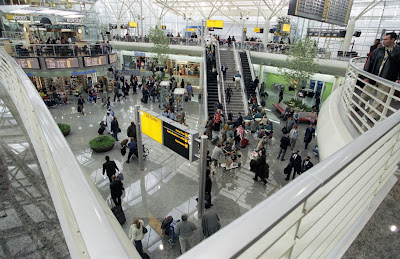
Look at the image above (click on any of the photos for a close-up view; click back on your internet brower to return to the home page). Can you guess the airport terminal? In real life this terminal existed only for the filming of the Steven Spielberg directed movie "The Terminal". Tom Hanks stars as a stranded visitor in a NYC airport. The Hopeful Traveler watches this movie for the set as much as for the story. The attention to detail and production design makes one hope that this terminal really existed in contrast to the cramp and tired terminals that exist in reality.

The entire three-story set was built as a free-standing piece of real architecture in a massive hangar in California that was used to repair 747 airplanes. The set included 60,000 square feet of genuine granite flooring and most notable, four working escalators; the first built exclusively for a movie set. The movie set was a feasible alternative due to the security and time constraints of filming at a live working airport.

The more realistic aspects of the set were the 35 retailers within the terminal. Part of the fun is spotting these stores and restaurants all designed to the retailer's standards and with an inventory of actual products.

Try and watch the movie and spot these retailers:
- Duty Free, Verizon Wireless, Dean and Deluca, Discovery Store, Brookstone, Cambridge Sound Works, Hugo Boss, La Perla, Hudson News, Borders Books, Paul Mitchell, Godiva, Swatch, Harry and David's and Origins.

Around the food court of the movie set, looks for these eateries:
- Burger King, Auntie Anne's Pretzels, Baskin-Robbins Ice Cream, Baja Fresh, Panda Express, Nathan's Famous, Au Bon Pain, Yoshinoya, S'barro's, Krispy Kreme, The Daily Grill and Starbucks.

Among real airport service companies, you'll find American Express Foreign Exchange, Citibank (ATMs) and Smarte Carte.

The movie press materials state that some of the food outlets, such as Starbucks, were staffed by actual employees. Where extras minded the store, they were given training sessions as if they were actually working behind the counter. Interesting fact: All the retailers agreed to build replicas of their stores without knowlege of the role their shop may play in the film.

Adding to the realism were the main flight information board and monitors which displayed actual flight schedules from the International Terminal at JFK International Airport.

The most prominent airline featured in the film is United Airlines for which the character played by Catherine Zeta-Jones is a flight attendant. There are also a couple of prominent scenes on the third level of the set which is the UAL first-class lounge.

One thing that the set decorator had to be mindful off: Any of the magazines at the retailers or any extra was holding could not have the image of the stars, Zeta-Jones or Hanks. Obvsiously why would a flight attendant or a stranded visitor be on the front of People magazine.

Why does the Hopeful Traveler enjoy the film? The main character has a reason for visiting NYC. He has a realistic purpose and accomplished it in the end. But along the way he experiences an adventure and meets people he will never forget.


"The Terminal" (2004) is available on DVD from Dreamworks Video. A bonus disc featuring material about the making of the movie is available on the hard-to-find three-disc collector's edition. More info about the film including 3D Virtual Tours of the set can be found at www.theterminal-themovie.com. Photographs: Dreamworks

Saturday, May 5, 2007

Just Passing By


When considering a one-day tour, an escorted tour or even a cruise itinerary, read the language carefully. The words "to see," "to view," or "to admire" are not the same as "to explore" or "to visit". For example, a description for a tour of Washington, D.C. may include "to see the Lincoln Memorial." This probably means that the route of the tour bus will pass by or briefly stop in front of the momument. It does not mean you actually have the opportunity to visit the memorial itself. Check the itinerary very carefully that the attractions your heart is hoping to visit is truly that, a visit and not a drive by.

Travel Agents for Escorted Tours and Cruises


With the internet, air fares and hotel rates are so accessible that most travelers no longer go through a travel agent. Still, a travel agent is a necessary component when planning complicated itineraries for escorted tours and cruises. Many travel agencies now specialize in these areas, one factor to consider when choosing an agent or agency.

The best place to start is recommendations from family or friends who have used a particular agent or agency. Second it's almost as important that the agent has the actual experience of say, taking a cruise or a coach tour in Europe. Once you have chosen the agent or agency, give them a call. Each agency can send you a number of travel brochures for different tour companies and cruises. From there, at your leisure, you can diligently choose the vacation that fits your purpose. You may choose to work via the internet but that first call and experience can help to give you an idea if you are comfortable with the travel agent.

For land tours, among the most respected are Trafalgar and Globus. Each company publishes tour brochures based on the part of the world you are wanting to visit. For example, the Trafalgar tour brochure for Europe will detail tours of various lengths and will encompass as few as two countries to a dozen or more. Each tour description details day by day what the tour includes. Some airlines also have an arm that will handle vacation options such as American Airline's AAVacations (www.aavactions.com)

For pricing of these tours, look at the hotels included in addition to attractions. The more central or upscale the hotel, the higher the cost. Hotels that are out of the city center will likely be included on a less expensive tour.

For cruises, your choice will likely be based on the ports of call as well as the ship and its amenities. Norwegian Cruise Line has gained some popularity for its freestyle cruising. Unlike traditional cruises, NCL's freestyle cruising have no fixed times for dinner, relaxed dress codes and your choice of restaurant. You can plan ahead or choose on a whim. Like the hotels for land tours, your choice of cabin on a cruise is a big factor when budgeting for your cruise.

Another important thing to consider when budgeting for a tour or cruise is the cost of activities that are not included in the base price. Land tour operators and cruises always have the optional excursions that can add at least a couple of hundred of dollars per person to the intial cost.

The best part of all for choosing an escorted tour or cruise is a lot of the planning is taken off of your shoulders. Just choose wisely and carefully for your purpose.

Tuesday, May 1, 2007

A Hopeful Travelers List


Once in a while The Hopeful Travelers will offer a top five list just for fun. As of this date, the H.T.'s Top Five Destinations are:

1) NEW YORK CITY
2) LONDON
3) TORONTO
4) LAS VEGAS
5) (tie) DISNEY WORLD & WASHINGTON, D.C.

As you can see the the H.T. loves the big cities. In a nut shell, NYC & London for their arts & culture and the all-day/all-night dymanics wherever you go. There is just something about Toronto. Great People, clean and safe with just enough diversions for a few days fun. Think of NYC or San Francisco but on a smaller scale. Las Vegas, well what's there to say...just ask anyone from Hawaii. Disney World & Washington, D.C. ties for the concentration of things to see and do in a limited area. The H.T. says Disney World rather than Orlando because it's possible to tie yourself up for five days just visiting the parks and resorts. Washington, D.C. because all the Federal sights are free and the history behind everything.

Sunday, April 29, 2007

Travel Books


There are four guide books that the Hopeful Traveler feels will best fit most travel needs. These are Frommer's, Eyewitness, Access and Fodor's. However there are many many guide books to choose from and there may be another book best suited to your purpose. The suggestion is to visit your major bookstore and review these books. Also when unsure about where to visit or just thinking about a trip, these books serve a valuable purpose of having a bundle of information at your fingertips. As much as the on-line search is easy, finding the information in one source can be unwielding.

The four recommended guide books are easy to use covering all aspects of travel from basic traveler needs to the more common researched information (hotels, sites). Frommer's and Fodor's are similarly designed in this manner. Eyewitness guides are colorful with lots of pictures and puts the information about what to see and do at the forefront. Travelers basic information is at the back section. Access guides compiles all the information by neighborhoods.

These books are updated regularly but the informaton may change little within one year. After checking out a book at say, your local bookstore, check out amazon.com to see if the book has been discounted to your favor compared to the in-store book price. Because the information contained in one book may be more than you need, some people have recommended that you head over to your public library and see if these books are available and photocopy the pages you need.

By the way Frommer's and Fodor's publish some of their guide information online (frommers.com, fodors.com). Most of the basic information found in their guidebooks can be found on their websites. If you find you're printing far too many pages from these websites, it may just be wise to invest in a hard copy of the guide. The Hopeful Traveler keeps the guides as souvenirs of a trip. If you're done with yours, pass it on to friends or donate it to your local library.

It should be noted that Frommer's and Fodor's publish guides for more destinations than Eyewitness or Access.

Wednesday, April 25, 2007

Finding Your Travel...


Just thinking where to start. There are far too many subjects to cover on the subject of traveling. But here it goes. Perhaps the best way to begin is for each of you to think what is the purpose of your trip. Some of you will say, "Take a cruise" or "Go to Vegas". But actually the purpose is in the details:

- If you want to take a cruise, why? What makes the cruise attractive to you and what exactly do you want to do on the cruise.
- If you want to go to Vegas, why? Winning a million dollars is something nice to dream about but it isn't realistic. What exactly will you do in Vegas that will satisfy you even if you don't win the "million". If your purpose is to just gamble, that's OK too.

You could even go into more detail when finding your ultimate purpose for every part of a trip:

- If you want to go to Europe, where in Europe? You might say "Paris"
- If you want to visit Paris, what do you want to see? You might say "The Eiffel Tower"
- If you want to see the Eiffel Tower, what would make visiting this attraction satisfying to you? Maybe a photo of you with a view of the city behind you.

So ask yourself:

What do I really want to accomplish?
Do I have one or many reasons to take this trip?
What will make the trip satisfying for me?
Is this an investment I am willing to make?
Am I reasonable in my expectations?

If you honestly answer these questions, then you will definitely have the beginnings of a great game plan for a satisfying trip.
Related Posts Plugin for WordPress, Blogger...